Can you explain what your PhD research is about and how this workshop fits into it? What key questions does it explore?
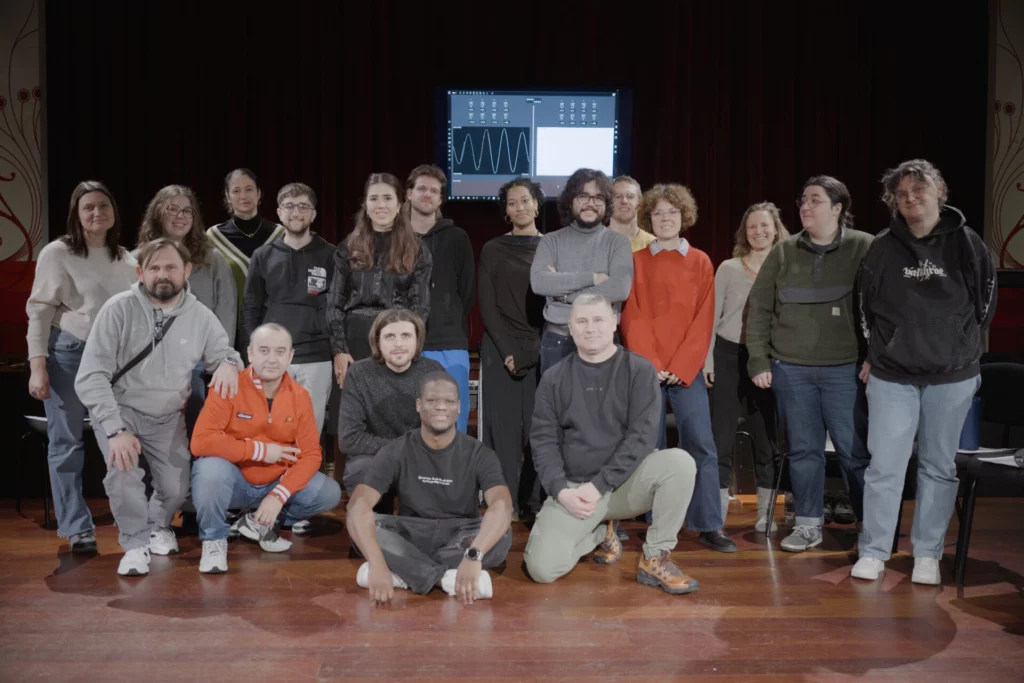
My PhD research aims to study innovative compositional and performative practices to facilitate music accessibility and participation for Deaf and Hard of Hearing people. This workshop is conceived as a field study with an experimental approach to test the haptic perception of sonic vibrations and to investigate the co-creation possibilities with a mixed group of participants including Deaf and hearing people. So, my key questions are: how to enhance an haptic experience with sonic vibrations? And, how to build a creative relationship between Deaf and hearing people?
You argue that sound perception is a “transmodal” process. Could you explain what this means?
With transmodal or cross-modal process, as well as multisensory perception, I refer to a way of listening that includes all our physical senses, and even our emotional sphere.
Why is it important to think about listening beyond just the ears?
The problem is that we live under the domain of hearing-centric cultures, so we are used to thinking of sound and music as auditory products, but this is not completely true. When I listen to music I can feel my entire body resonating with it, and activating an embodied approach to listening can open a higher level of music engagement and appreciation. I think that Deaf culture can teach us a lot about embodied listening, and we can work together to explore this world of music making.
How does the body become a real tool for listening in this workshop?
Through tactile perception and listening awareness the participants can activate different parts of their body and their presence in the surrounding space. Body is rediscovered as a resonating chamber with sonic vibrations coming from the inside and the outside.
How can we redefine our relationship with silence in this context?
Silence is really important and, like breathing, is essential to focus on the creation of that necessary space to let your hearing habits change from a mere auditory perception to a multisensory experience. So, let’s say that silence is the way to listen beyond just hearing sounds, and learn what you can perceive on your skin if you are “forced” into silence.
Why was it essential for you that this workshop be open to both Deaf and hearing participants?
From my personal point of view as a hearing musician and researcher, I cannot fully understand Deaf perceptual experience without integrating their point of view. In general, it’s important because I’m interested to see what happens when Deaf and hearing people are invited to collaborate on sound making.
What can these two audiences bring to each other in a shared creative space?
I’m very curious to learn this during the workshop. I cannot really imagine what could happen, and I’m really excited to see it.
Why is it important for you to create spaces for shared listening?
Because I believe that listening is a very personal and subjective experience and doing it in a shared environment and collective experience can bring those individualities feeling part of a community.
How does accessibility influence the way you design a sound-based artwork?
Well, technically speaking it influences my work in the way that I need to look for Deaf artists to collaborate with. And from there the creative process develops in the engagement of specific sonic frequencies range to make my musical outputs.
Why did you choose electronic instruments as creative tools?
Because they are most accessible and user friendly sound production instruments for somebody that has no musical education, whether he is deaf or hearing.
Can we talk about hearing prevention here in ways other than just through decibel levels?
Nowadays, we live immersed in sound pollution. Everywhere there is a “loudness war”, and I’m not referring just to the one in the music industry. Clubs, concerts, live shows are also getting louder and louder. Of course this is very difficult to change, but in my small way I try to do some hearing prevention. Being a musician, I like to work on dynamics where soft and loud moments have their own importance. I’m not playing loud just for the shake of playing loud. As a listener, I never use earphones to listen to music and when I go to live concerts I always wear earplugs: frequencies around 2 – 5 kHz, and their reflection in the room, no matter how loud or soft they are, can be destructive to our ears.
How does this workshop reflect your artistic universe?
This workshop is an intermediate step between where I come from — classical music education, experimental and contemporary music original projects, multidisciplinary collaborations – and where I want to go: the development of a new kind of live sound performances for a multisensory fruition and accessible to different listening abilities.